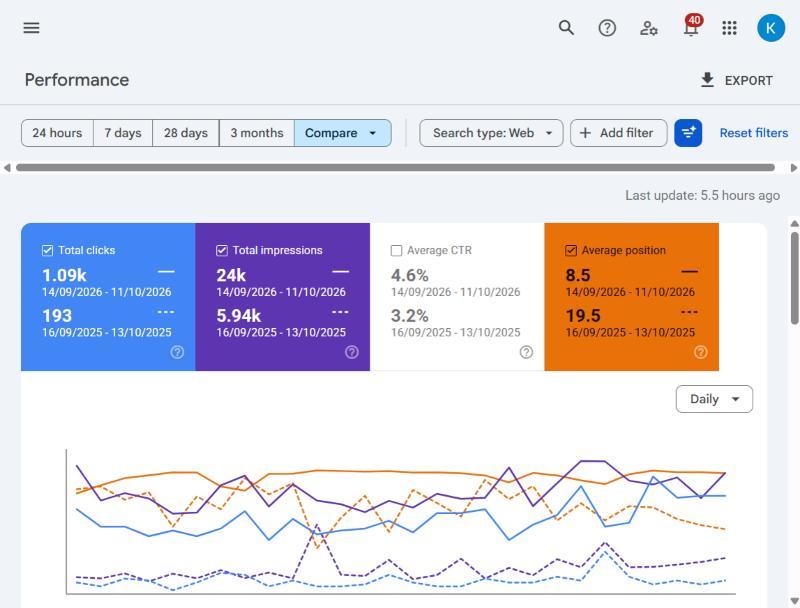
Tactical Kit is an online store selling leather holsters made in-house. The website runs on the Horoshop platform. The client approached us for SEO services in September 2025 to reduce their reliance on expensive paid search advertising. We worked for a total of 5 months, with breaks, over a 12-month period. During that time, Google organic search went from a secondary channel to a source of 39.09% of purchases on the website.
Tactical Kit is a Ukrainian manufacturer that makes leather holsters for PM, FORT, Glock, TT, Beretta, CZ, APS and Flobert revolvers and sells them through its own online store. Its range also includes gun slings, cases, magazine pouches, retention lanyards, safes and men’s leather accessories. The website has two language versions.
Before working with us, sales came almost entirely from Google advertising (Performance Max campaigns). The owner came to us with a specific request: stop spending most of the marketing budget on advertising and develop a second sales channel.
- Niche: e-commerce, tactical gear (leather holsters and accessories)
- Platform: Horoshop
- Region: Ukraine, two language versions
- Engagement period: September 2025 to present; 5 active months over 12 calendar months
We defined the goal in terms of orders rather than rankings: shoppers needed to find a holster on Google without clicking an ad and place an order on the website.
What made the task more challenging:
- SEO from scratch. The website had never been promoted through organic search, and Search Console had not been set up. Every stage had to start from scratch.
- A limited budget and breaks in the work. Other business expenses regularly required funds to be redirected from the marketing budget. As a result, we worked for only 5 of the 12 months, and every active month had to deliver the maximum possible results.
- An illogical catalogue structure. There were no dedicated pages for popular queries such as “кобура для Glock 17 прихованого носіння” or “оперативна кобура для ТТ”, and some products were assigned to categories without a clear rationale.
- The same product range on the client’s second website. The owner also has a store on Prom selling holsters, magazine pouches and safes. We checked whether the two sites competed with each other in search. The Prom store had no organic traffic and did not interfere with the main website, so there was no need to close or rebuild it.
- Purchases from Google organic search: grew from 2 to 43 — 21.5 times as many.
- Sessions from Google organic search: grew from 187 to 1 199 — 6.4 times as many.
- Keyword rankings: of 1 137 tracked queries, top 10 — 128 on 26.09.2025; final tally — 764 on 14.10.2026.
- Non-branded search drove the growth: branded clicks account for less than 1% of the total.
GA4: September 2026 compared with September 2025; sessions and purchases by traffic source and medium
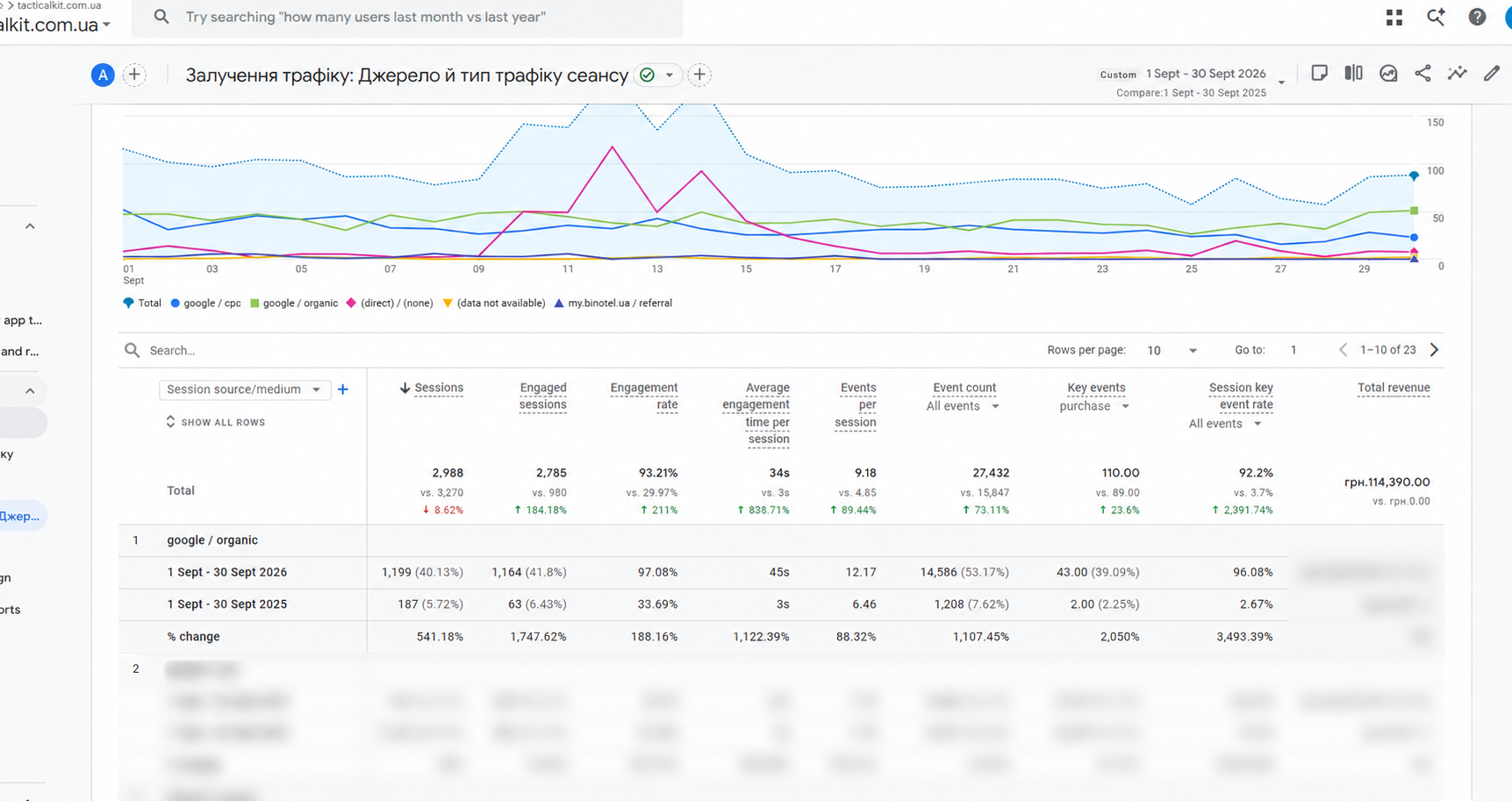
The website generated sales, but Google organic search played only a small role. In September 2025, this channel delivered 187 sessions and 2 purchases — 5.72% of all sessions and 2.25% of all purchases on the website. In total, the site received 3 270 sessions and 89 purchases that month.
- Rankings. In the first snapshot, dated 26.09.2025, of the 1 137 queries across the two keyword sets, 128 ranked in the top 10 and only 12 in the top 3. The website did not appear in the top hundred results for “кобура” or “кобура для пистолета”.
- Search analytics. Search Console had not been set up, so our first step was to verify the website together with the owner.
- Structure and content. There were too few pages targeting holster types and firearm models, category pages had no copy, and meta tags had not been tailored to search demand.
The logic was simple: it is better to cover search demand fully within one category and bring it into the top results than to spread resources across the whole catalogue and achieve little in any category. Within each category, we started with queries closest to a purchase: “holster for a specific model + carry type”.
Sequence of work:
- Structure and keyword research. Collect holster-related search queries and create dedicated landing pages for them.
- Technical foundation. Remove obstacles that prevent new pages from being indexed and ranking.
- Copy. Add content to the key pages.
- Links. Build external link equity once the website has pages to which it can be directed.
Competitor analysis. We checked which sites ranked at the top for “оперативная кобура скрытого ношения” (November 2025 snapshot). The leading positions were held by marketplaces (Rozetka, OLX, Prom) and specialist tactical gear stores. The specialist stores had something in common: a dedicated page for that holster type or firearm model, such as “кобуры скрытого ношения” or “кобуры для ПМ”. Competitors had many external links to their domains overall. Tactical Kit did not appear in the results at all. The store had products matching the query, but no dedicated page for it, and the existing categories were not optimised.
This set the priority: landing pages for “carry type + model” first, then links. In August 2026, the new “кобури прихованого носіння” page reached 3rd place for this query. Only Prom and Epicentr ranked above it; all the specialist stores that had been at the top in autumn ranked below it.
We implemented all recommendations from the first audit (October 2025) on the website, alongside publishing the copy. The audit aimed to ensure that new pages were indexed correctly and to eliminate duplication:
- URLs. We removed unnecessary nesting from product URLs (suffixes such as /722/): we made product names unique and updated their URL aliases.
- Broken links. We fixed links returning 404 errors in the “Holsters” category copy and on product pages, set up a 301 redirect from a deleted category flagged in Search Console, and replaced external links that redirected on the delivery and privacy policy pages.
- Meta tags and headings. We fixed title tags that were too short, titles duplicating H1 headings, duplicate meta descriptions, and missing or duplicate H1 headings. We added manually written meta tags to categories and filters covered by the keyword research, and template-based tags to products and categories not covered by it. We worked separately on the homepage and utility pages. We removed empty H2 headings from product descriptions.
- Images. We added alt attributes to images in banners, on the “About us” page and in product descriptions.
- Sitemap.xml. We removed pages that returned 404 errors.
- Internal links. In the specifications section of product pages, we added links to enabled filter pages by material, carry type and attachment type.
- Other fixes. We corrected the phone number format in the page code and hid a utility catalogue page that was not needed for search.
The follow-up audit in August 2026 identified issues that had accumulated over a year of catalogue expansion:
- unnecessary URL nesting on 745 pages;
- broken images on 127 pages;
- 404 pages in Search Console (deleted products): we proposed 301 redirects to categories and explained to the owner why it is better to mark a product as “out of stock” than to delete it;
- multiple H1 headings on a page;
- problematic title tags and meta descriptions on 9 pages;
- broken links in sitemap.xml.
Keyword research and landing pages accounted for most of the work. Across two iterations, we collected 144 groups for the website’s two language versions — a total of 1 197 queries. For groups with search volume, we created 37 new pages, including “кобури для Glock”, “кобура прихованого носіння для Glock 17”, “оперативна кобура для ТТ” and “кобура під револьвер Флобера”, with separate pages for firearm models and carry types. Some were built from Horoshop filters that had previously not been indexed.
We prepared copy for the website’s two language versions. For category and filter pages, we wrote and published 20 pieces covering holsters for Glock 17 and 19, concealed-carry and shoulder holsters, belt holsters for TT, and holsters for Beretta, APS and Flobert revolvers.
Each piece went through a two-stage review. First, an SEO specialist checked for keyword stuffing. Then the owner reviewed the copy: he knows the product better than any copywriter, and we incorporated his feedback before publication.
During this work, we noticed a holster product page with a desk lamp description and asked the client to correct it.
After the second batch of copy was published, rankings improved across all groups where it was added, in both language versions of the website.
We began buying links once the website had optimised pages to receive link equity. We placed 19 articles with dofollow links on regional news and city websites: 13 in November–December 2025 and another 6 in January–February 2026.
The articles addressed shoppers’ questions and concerns: how to choose a holster and avoid common mistakes, leather versus plastic, attachment types for PM holsters, caring for leather products, and choosing a gun safe. We wrote in both languages. Before buying placements, we analysed competitors’ backlink profiles.
We assessed referring websites by their DR and organic traffic in Ahrefs at the time of placement:
- DR: from 31 to 81
- organic traffic: all websites had more than 2 000 per month, and 12 had more than 5 000
We used naked-URL and branded anchors: the website address or the store name (“Tactical Kit”, “Тактікал Кіт”, “інтернет-магазин Тактікал Кіт”). This is the safest option for a young backlink profile. Some links point directly to categories rather than the homepage, such as the category for PM holsters.
Google was showing the wrong holster. In February 2026, the owner reported that the query “Buy an operational holster for Fort 12” returned a completely different holster — an olive-coloured model with a MOLLE attachment — and that this was happening in every category. We investigated during a screen-sharing call.
The cause was the old structure. Previously, all FORT holsters were in a single category, “holster for Fort 12/14/17/20”. The CMS turned the slashes in the name into a URL structured as /kobury-pod-fort-12/14/17/20/. A single page with no copy was supposed to rank for every model at once, so Google returned unrelated pages for model-specific queries.
The solution: dedicated pages for each FORT model, built from filters and given their own meta tags. We redirected the old URL to the category. After indexing, the correct page began ranking for model-specific queries. For “holster Fort 17”, the website moved from 63rd to 5th place; for “holster for Fort 17”, it moved from 27th to 6th.
After 4 active months, in February 2026, visibility had already improved noticeably. Monthly organic sessions reached 577, with 19 purchases from search.
The most interesting development came during the break. From March to July 2026, we carried out no work, yet organic performance kept growing: sessions increased from 789 to 1 269 per month, and purchases from 20 to 35. This was the delayed effect of Google gradually reassessing the pages, copy and links created during the winter.
Maryna, Senior SEO Specialist, comments: “Organic traffic grew during the break because we had already fully optimised the website: we created all the pages, added meta tags and implemented the audit recommendations. We did not put off any changes; everything was implemented immediately. While the client was on a break, it was indexed and began delivering results. The website also runs on Horoshop, which provides a solid technical SEO foundation.”
| Metric |
Before (point A) |
After |
| Sessions from Google organic search (GA4) |
187 |
1 199 |
| Purchases from Google organic search (GA4) |
2 |
43 |
| Google organic search’s share of all purchases |
2.25% |
39.09% |
| Queries in the top 10 |
128 |
764 |
| Queries in the top 3 |
12 |
214 |
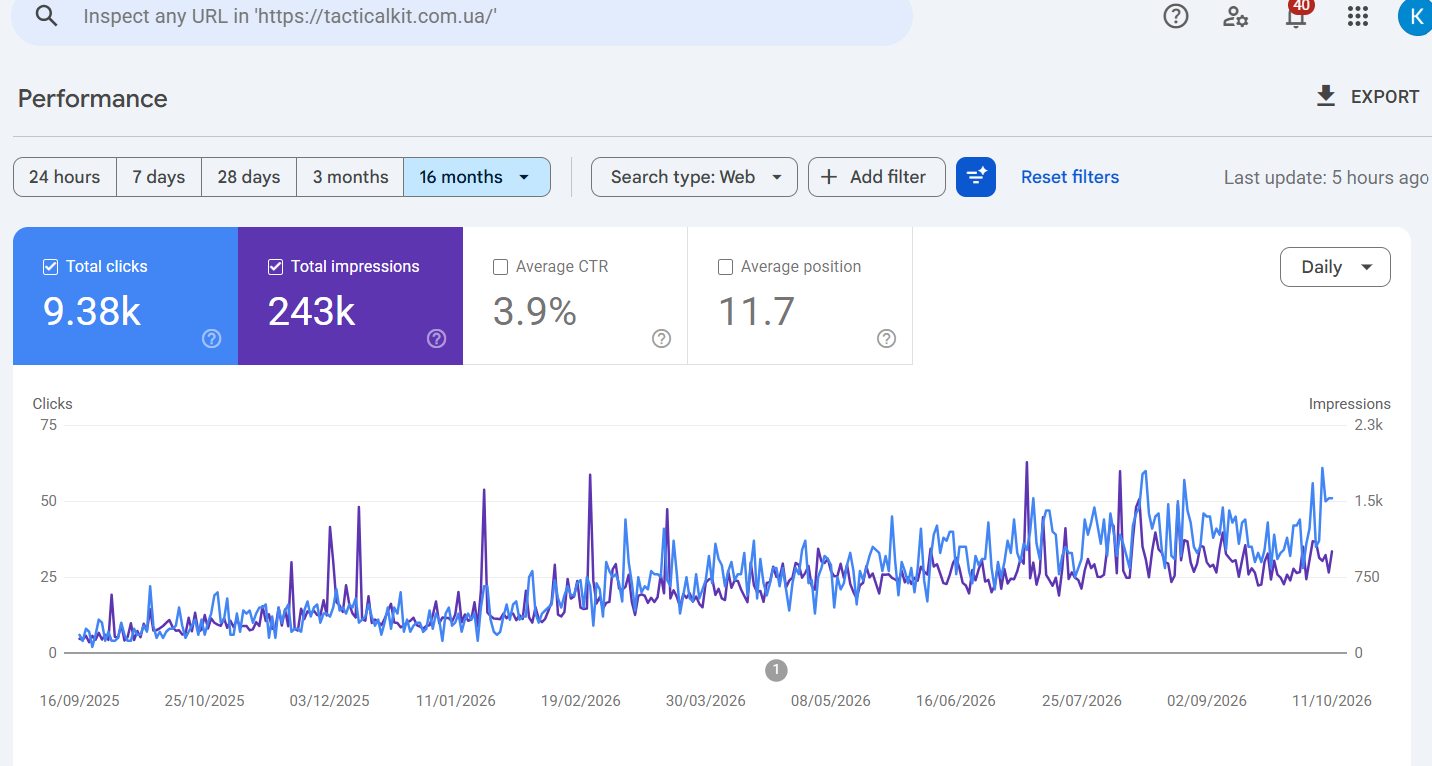
Screenshots from GA4 and Search Console
Search Console: clicks, impressions and position, 16.09.2025–11.10.2026
Search Console: the first 28 days compared with the last 28 days