Even with steady traffic, a website may fail to sell, engage visitors, or meet its business goals. It is crucial that every user can quickly find the right products or services and place an order on their very first visit. Complicated navigation, cluttered pages, unclear buttons, extra steps in a request form — all of this lowers conversion and increases bounce rate.

According to Baymard Institute research, on average up to 70% of potential conversions are lost not because of a lack of demand, but because of user experience problems.
A website usability analysis helps identify weak spots and interface flaws, improve behavioral metrics, and make it easier for users to interact with your website.
The result of a website UX audit is a set of practical recommendations for improving the site. By implementing them, you can increase your conversion rate and reduce your bounce rate, and therefore improve the overall profitability of your website.
With growing competition and rising traffic costs, UX is becoming one of the key factors in website performance. That’s why a usability audit is not an option reserved for large projects, but a working tool for businesses of any size.
According to Nielsen Norman Group, users most often leave websites when they are forced to “figure out what to do next”.
A UX audit is a comprehensive service from the Site24 agency that includes checking how convenient a website is for users. A usability audit shows how easy it is for visitors and regular customers to find the information they need, place an order online, or contact the company.
The audit analyzes not design as such, but the logic of interaction: page structure, user behavior scenarios, clarity of controls, and the speed of decision-making. Most often, an audit combines an expert review (based on UX principles and heuristics) with data analysis: user behavior, exit points, and sales funnels.
Google also takes behavioral metrics and UX signals into account in rankings, which helps a site grow its positions and organic traffic.
The main goal of a usability audit is to turn your website from a simple online business card into an effective sales tool. To do this, you need to identify and remove every barrier that keeps visitors from completing the target action.

A website usability audit makes sense in several cases:
- When launching a new website. This ensures that the design, structure, and navigation are convenient and clear for users.
- Before launching a large-scale advertising campaign. Very often, ads fail to deliver results precisely because of website issues, and an audit will help you avoid this.
- When website performance declines. If you notice lower conversion, a higher bounce rate, or other problems, it’s worth running an audit. It will reveal the causes and possible solutions.
- On a regular basis. User expectations and habits change, and new technologies and UX design trends emerge. That’s why it’s important to check your site periodically and update it.
A UX audit is especially necessary when a site gets traffic but few sales. Increasing the conversion rate is the main goal of a UX audit.
Now let’s look at how to conduct a website usability audit and which key aspects our specialists analyze:
- Navigation. Checking how easy it is to find any page and get back to the homepage from it.
- Page structure. Analyzing whether the structure is logical, fits its purpose, and keeps key elements visible (order form, CTA, contacts).
- Design and visuals. Font readability, visual emphasis, element contrast — everything that affects perception.
- User interaction scenarios. How easy and clear it is to fill in forms and complete other target actions.
- Responsiveness. Correct display and behavior of elements on mobile devices.
- Loading speed. Pages and elements should load quickly and without glitches.
- Ease of content perception. Text structure, headings, readability, and other factors.
The result of this analysis is not abstract advice, but a specific checklist of issues and improvements tied to the website’s business goals.
A usability audit is useful for any type of website. However, for several categories it is simply essential, because usability on these sites directly affects sales and, as a result, business revenue.
These categories, and why it matters for them:
- Online stores. Catalog structure affects how quickly and easily users find products. The convenience of the cart and checkout directly affects the number of sales.
- Corporate and service websites. Users need to find the right services and information quickly, and the ordering process must be intuitive.
- Landing pages (one-page websites). Their job is to convert a visitor into a buyer or client. An audit helps find even the smallest flaws that get in the way.
- Media and information portals. They usually have a complex structure and a large, growing volume of content.
- Startup websites. At an early stage, an audit helps avoid critical mistakes and audience loss.
- SaaS projects and user dashboards. Complex interfaces and unclear scenarios reduce user engagement and retention.
- Websites with a high share of mobile traffic. Mobile UX often becomes a source of critical errors and losses.
It’s important to run an audit not only when problems have already appeared. It’s much more cost-effective to find and fix flaws before they cause problems and losses for your business. The Site24 agency team will help you with this!
The usability analysis process can be broken down into several stages. It’s important for the client to know how the work is done and what they will get in the end.
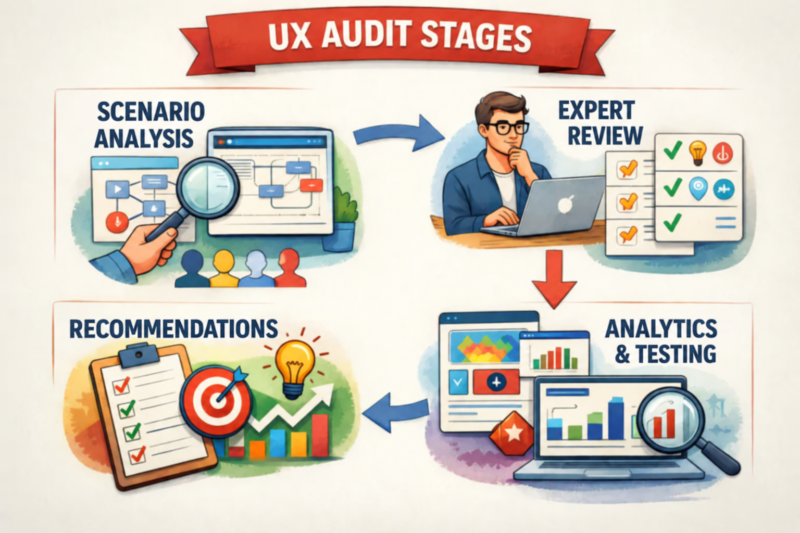
In a professional approach, an audit always starts with setting goals: which business metrics need to improve (conversion, page depth, leads, sales).
- Data collection and analytics. We collect data on visits and user behavior. We identify where users leave the site and which pages cause difficulties.
- Expert website review. We evaluate the structure, design, and content against a checklist. We manually identify problem areas that reduce orders and increase traffic loss.
- User scenario testing. We check how convenient it is to complete target actions: find information, a product, or a service, and place an order.
- Report and recommendations. We prepare a detailed report and recommendations to eliminate flaws and increase conversion and profitability.
- Detailed, structured work plan. We prioritize recommendations by urgency and expected impact (top-priority ones and those that can be implemented as the site evolves).
So, if you order a website usability audit from us, you get a strategic improvement plan that delivers maximum impact at an optimal investment.
The value of a usability audit is only realized once it’s implemented. Practice shows that the best results come when recommendations are built into the product or marketing process instead of remaining “a document for the sake of a document”.
Step one: focus on priorities. According to the Baymard Institute approach, fixing even a few critical UX errors can have a bigger impact than large-scale interface changes:

Next, an implementation plan is created:
- quick wins
- medium-term improvements
- changes that require a redesign or development
After implementation, it’s important to measure the metrics again: conversion, session depth, and behavior in key scenarios.
Keep in mind that UX is not a one-time task. The best digital products use audits as a cyclical optimization tool, returning to analysis after scaling, a change in target audience, or the launch of new traffic channels.
The cost of a usability audit is not based on the number of pages; it depends on the type of website and the scope of analysis. A minimal landing page audit and a comprehensive analysis of an e-commerce or SaaS platform are fundamentally different tasks in scope.
The price depends on:
- the type of website and the complexity of user scenarios;
- the number of pages and funnels analyzed;
- the use of analytics data and user research;
- the deliverable format (checklist, roadmap, presentation for the team);
- the contractor’s level of expertise.
According to industry reviews, a professional UX audit costs less than a redesign but can multiply its effectiveness. Forrester has repeatedly emphasized that UX investments deliver a high return through higher conversion and retention.
So an audit is not an expense, but a risk reduction tool for your further investments.
To find out the exact price and order an audit, write to us or call us for a preliminary consultation.
Ordering a website usability audit makes sense in several cases:
- traffic is growing but conversion isn’t;
- a high bounce rate on key pages;
- complex or long user journeys;
- preparing for a redesign or entering new markets;
- a feeling that “something is wrong with the website”, but it’s unclear what exactly.
Nielsen Norman Group notes that interfaces that don’t match the user’s mental model lose trust at the early stages of interaction.
A UX audit lets you test hypotheses and make decisions before problems start directly affecting your revenue.
If any of these points apply to you, write or call us! The Site24 team will help make your website effective and profitable!