PPC for an FPV Drone and Parts Online Store: 7,690% ROAS in August 2026

#Case Site24
30.10.2026
Author: Kateryna Zolotareva

An online store selling FPV drones, goggles and parts on the Horoshop platform came to us with no Google advertising at all. We launched the account from scratch in March 2024, and the first sales came in on day two. Two and a half years later, in August 2026, the same account was bringing in orders with an average value five times higher than a year earlier, while the cost per acquired order dropped by 29% month over month.

ROAS 1,766% → 7,690% (August 2025 → August 2026) · cost per order UAH 752 → 532 (July → August 2026)

About the client

The client is a Ukrainian online store for people who build and maintain FPV drones. The catalog includes ready-to-fly quadcopters, Skyzone video goggles, RadioMaster controllers, transmitter modules and video transmitters, cameras (including thermal imaging ones), carbon frames, motors and flight stacks. At launch, the range was about 100 products. A large share of buyers are military: the owner asked us to advertise the SKY04X Pro goggles with an emphasis on their camouflage color, specifically for this audience.

The site runs on Horoshop, a Ukrainian e-commerce platform, and has Ukrainian and Russian versions. Products in this niche are expensive and sell out fast: an item can be out of stock for several weeks until the next delivery.

  • Niche: e-commerce, FPV drones and parts
  • Service: PPC — Google Ads
  • Channels: Performance Max, Shopping campaigns, remarketing
  • Platform: Horoshop, two language versions (UA / RU)
  • Region: Ukraine
  • Partnership: since March 2024, ongoing
  • Ad budget: from UAH 500 per day at launch to an average of ~UAH 1,570 per day in fall 2025

Goals and challenges

The owner wanted one thing: for advertising to sell. Not reach and not clicks, but orders placed on the site that pay back the ad budget. We deliberately did not offer SEO at the start. For a store with about a hundred products, the faster return comes from ads that show the product with its price and photo right in the search results.

Several things stood in the way, all typical of this niche:

  • Stock that changes every week. Popular goggles and controllers sold out within days, while the next batch took weeks to arrive. A campaign that sold well on Monday could be left with nothing to sell by Wednesday.
  • Constantly shifting priorities. Every month the client sent a new list of items to push harder: a new goggle model, a thermal camera, a 13-inch frame. The account had to adapt quickly without breaking Google’s algorithm learning.
  • Fake orders. The store regularly received orders worth hundreds of thousands and even millions of hryvnias that nobody intended to pay for. For Google Ads these are ordinary conversions: they distort the statistics and train automated bidding on false data.
  • Auction competition. In Shopping results for goggles and parts, the store competes with dozens of advertisers. In August 2026, 50 other stores appeared alongside it, including the Prom and Temu marketplaces.

Key results

The headline: in August 2026, advertising brought in the highest-value orders in the account’s history, and the cost per order fell sharply after a weak July.

  • ROAS (return on ad spend: order value divided by spend) in August 2026: 7,690%. A year earlier it was 1,766%, 4.4 times lower.
  • Average order value from ads: UAH 7,799 → 40,941 (August 2025 → August 2026), ×5.3.
  • Orders from ads: 43.4 → 72.5 per month (July → August 2026), +67%.
  • Cost per order (CPA): UAH 752 → 532 (July → August 2026), −29%.
  • Conversion rate (CR), the share of clicks that ended in an order: 2.58% → 3.15%.
  • Cost per click (CPC): UAH 19.41 → 16.76 (−14%), even though the auction got more competitive.
  • All time: 87,489 clicks and 2,357 placed orders at an average cost of UAH 440.

Starting point (point A)

In March 2024, the store had none of the things that advertising for an online store usually starts with. There was no Google Ads account and no Merchant Center. Nobody had built a product feed, and sales on the site were not tracked at all. The client gave us access to Google Tag Manager and the Horoshop admin panel; everything else we created ourselves.

For Merchant Center (the Google service that feeds a store’s products into ads) to pass review, the client had to verify a phone number and add a business address to the site. Without that, the account risked being suspended. We deliberately linked the ad account to Merchant Center only after the review, to avoid an automatic suspension.

Strategy and approach

With this kind of range, we bet on product ads: Shopping campaigns and Performance Max (a campaign type in which Google itself distributes product impressions across Search, Shopping, YouTube and partner sites). An FPV equipment buyer usually searches for a specific model: “Skyzone SKY04X Pro”, “RadioMaster TX16S”. A product listing with a price in the results answers that search more precisely than a text ad.

We built the account logic around the two things the owner actually controls: product price and stock:

  1. First, run ads across the whole catalog and see what sells.
  2. Move the client’s priority items into separate campaigns to guarantee them budget.
  3. Split the rest of the range into price segments so that more expensive products get more budget.

We set up cross-campaign negatives: each product is advertised in only one campaign, so campaigns do not compete with each other for the same impression.

What we did

The work was continuous, with a monthly report and plan for the client:

  • Stage 1 (March–April 2024): launch from scratch. Analytics, Merchant Center, two feeds, the first 3–4 campaigns.
  • Stage 2 (May 2024 – February 2025): focus on priorities. Separate campaigns for products the client wanted to sell harder, and pauses for those that sold out. Over this period, 19 campaigns passed through the account: some were launched for a new priority, others switched off when the product ran out.
  • Stage 3 (from March 2025): price segments. The main campaigns were split by product price, and each segment got its own bidding strategy. Separate priority campaigns ran until the end of 2025 and were then merged into one. Goggles got a campaign of their own. 12 campaigns operate at this stage.
  • Ongoing: bid and budget optimization, cross-campaign negatives, stock and product review monitoring, auction analysis.

1. Analytics and sales tracking

Through Google Tag Manager, we set up order tracking from the site to Google Ads, including order value. Automated bidding strategies learn from exactly this data. We verified the setup on real sales in the very first week: on March 14, 2024 the account recorded two orders, and the client confirmed they were real. By March 18, the account already showed 31 conversions.

2. Feed and Merchant Center

A feed is a file listing all of a store’s products: names, prices, photos, availability. Google takes everything it shows in ads from it. We built two feeds, Ukrainian and Russian, to cover searches in both languages. Stock status is passed into the feed, so out-of-stock products are not shown and no budget is spent on them.

After that, the feed needed constant attention, because any new product could fail review. What we had to fix:

  • required attributes (title and description) filled in only in one section of the Horoshop product card;
  • Cyrillic characters in SKUs and product IDs that were too long;
  • empty product card fields and an unticked “add to GMC feed” box for new products;
  • photos Google could not crawl. We worked this out together with Merchant Center and Horoshop support.

3. Account structure and campaign types

The structure changed along with the client’s range and priorities.

  • Shopping campaigns for the whole catalog. We started with these on March 13, 2024, one each for the Ukrainian and Russian feeds. Later the Russian-language Performance Max almost stopped bringing in orders, and we switched it off.
  • Campaigns for priority products. Ready-to-fly GEPRC and iFlight drones, the RadioMaster TX16S controller, Skyzone SKY04X Pro and Cobra X V4 goggles, the EMAX Aeris Link transmitter module, the Thermal 256 thermal camera. At first, almost every priority had its own campaign. Now all priorities sit in one campaign with its own budget, so they do not take money from the price segments.
  • Goggles, separately. This is the store’s most expensive and best-selling product, so goggles have their own campaign and budget. This is where we clean search terms most thoroughly.
  • Price segments. Since March 2025, the main range has been advertised in three campaigns: UAH 1,000–5,000, 5,000–15,000 and over 15,000. The logic is simple: spend less on cheap products and more on expensive ones. Priority products and goggles are excluded from these campaigns to avoid duplication.
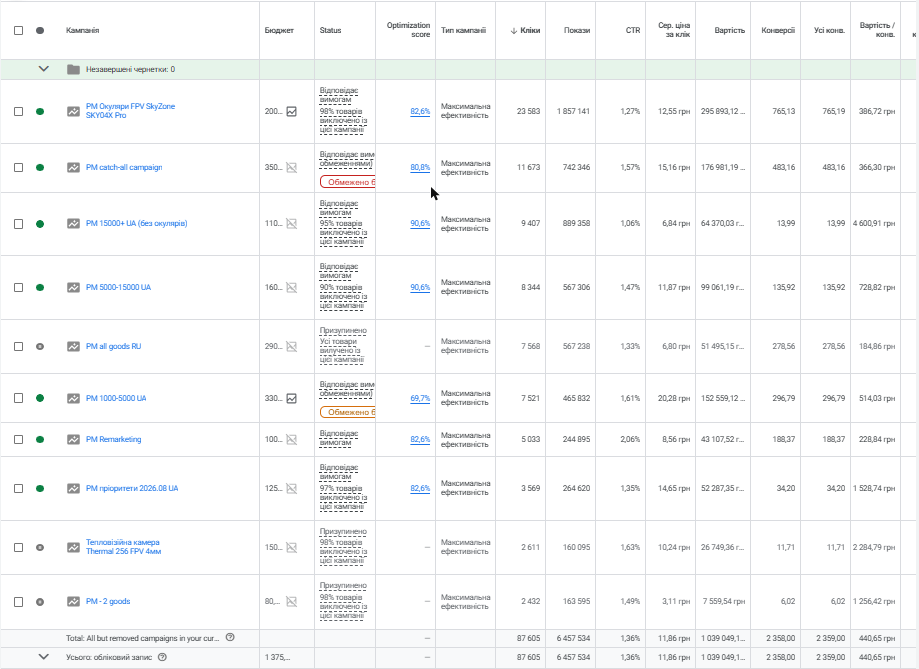
  • Catch-all campaign: picks up products that did not land in any other campaign. Over all time, it is the account’s second-largest campaign by spend: 11,670 clicks and 483 orders.
  • Remarketing: for people who have already visited the site, with 5,034 clicks and 188 orders over all time.

We add a new priority product to the ads following a clear routine. First, we check that the client has set all the required flags in the Horoshop product card. Then we wait for the product to appear in the feed and in Merchant Center. Only after that do we add it to the priority campaign.

In August 2026, all impressions and orders came from Performance Max.

Google Ads campaigns over the whole period: goggles, catch-all, price segments, remarketing, priorities

Account campaigns over the whole period (March 2024 – October 2026), top 10 of 23 by clicks. Green dot: campaign is active; gray: paused. Interface in Ukrainian.

4. Bids and budgets

The daily budget grew along with the results: UAH 500 at launch, then 670, 870 and 990 per day. In fall 2025, it averaged ~UAH 1,570 per day. Each price segment got its own automated bidding strategy suited to its goal:

  • UAH 1,000–5,000: a strategy capping cost per conversion, so we do not spend more on cheap products than a sale brings in;
  • UAH 5,000–15,000: Maximize conversion value, because here it matters to earn more from each order;
  • over UAH 15,000: Maximize conversions, because in the expensive segment every order is profitable on its own, so the more of them the better.

At first this setup worked, but over time strategies stagnate. If, for example, a cost-per-conversion cap is left unchanged for too long, the algorithm stops hitting the target and the campaign slumps. So we change strategies periodically. In August 2026 we tested strategies again, reallocated budgets between campaigns and turned off automatic image optimization. The SKY04X Pro goggles campaign currently runs on Maximize conversion value.

When a priority product sold out, we paused its campaign and moved the budget to items in stock. That happened with the goggles in summer 2024 and in July 2026. As soon as the product came back, we switched the ads back on: the SKY04X Pro goggles returned to the ads on August 24, 2026.

5. Hypothesis testing

  • A Shopping campaign with a 1-kopeck bid: didn’t work. In August 2025, the client asked us to stop advertising the GEPRC Cinebot30 HD Nebula PRO drone and move the budget to a new item. We did not switch it off completely: we removed it from the main campaigns and kept it only in remarketing and in a Shopping campaign with the minimum bid. The idea was nearly free impressions and at least one sale of an expensive product that would pay for everything. In practice, the campaign barely got any impressions: the algorithm favors products that already generate sales. Over all time it brought 14 clicks and 2 orders worth UAH 5,200. Account results with and without it were practically the same.
  • “A separate campaign for each priority”: dropped. Separate campaigns for 1–2 products fragmented the budget. Google spent each one’s full daily budget, but not necessarily on targeted impressions. When a delivery was delayed by 2–3 weeks, such a campaign simply stopped, and once the product arrived it had to be relaunched. In fall 2025 we suggested the client consolidate the structure, and all priorities were merged into one shared campaign. Now, when one product sells out, the ads simply switch to other priorities, and there is far less manual work with pauses. The effect of consolidation cannot be measured on its own: at the same time we were raising budgets, moved goggles into a separate campaign, and tested geo and bidding strategies.
  • Geo test for goggles. Regions where goggles were shown but did not sell were moved into a separate campaign. Over 66 clicks it brought one order with no value, so we stopped it, and the main goggles campaign runs without those regions.
  • Restructuring mid-month. In September 2024, new campaigns for a fresh priority list coincided with a Horoshop outage. The algorithms spent several days re-learning, and orders came in at one a day. Lesson learned: avoid major structural changes at the same time as other disruptions, and exclude outage days from learning data.

Comment from Anastasiia, PPC specialist: “When every priority product had its own campaign, any 2–3 week delivery delay stopped it. We’d pause the campaign, then the product would come back, and everything started over. In one shared campaign this solved itself: one product sells out, and the ads keep working for the other priorities. And the budget is no longer spread thin.”

6. Problems solved along the way

  • Fake orders worth millions. Google Ads counts a placed order, not a paid one. So orders worth UAH 943,000, 1,782,000 or 3,164,550 that nobody paid for showed up in the statistics as sales. The client suspected competitors. Solution: the client sends a list of invalid orders, and we subtract them in every report so that ROAS reflects reality. Some of the “fakes” turned out to be duplicates caused by online payment failures. For those, we advised the client to make cash on delivery the default payment method.
  • Ads stopped because of the balance. The client tops up the budget themselves, and the balance often ran out. After a top-up, Google “caught up” and spent up to 2–3 daily budgets in one day. We advised keeping at least 3 days’ worth in reserve so campaigns would not interrupt learning.
  • Products failed review. In 2025, Merchant Center refused photos of new products for weeks. Merchant Center support pointed to crawl restrictions on the server side, and we found that the same photo on the site opened at different URLs. After correspondence with Google and Horoshop, the products passed review in mid-September 2025, and the thermal camera was immediately launched in its own campaign.
  • Platform outages. On September 10, 2024, Horoshop was down for almost a full day, and we paused the ads so as not to waste budget on a site that wasn’t working. In September 2026, after an attack on the platform, orders could not be placed on the site. We stopped the ads and then switched them back on in test mode.
  • “I want to be first for Skyzone”. The client wanted the store to always appear first for the goggle brand. We explained that search results are personalized and Google does not give 100% of auctions to a single advertiser. As of January 2026, the store ranked first by ad impressions for goggles, winning 81.92% of auctions.

Interim results

Quarterly dynamics (Google Ads, whole account; orders are placed, not paid):

Quarter Spend, UAH Clicks Orders CPA, UAH CR CPC, UAH What happened
Q1 2024 (from 03/07) 11,732 1,928 115 102 5.97% 6.08 launch from scratch, first sales
Q2 2024 69,940 10,313 324 216 3.14% 6.78 priority campaigns, budget growth
Q3 2024 98,481 9,829 297 332 3.02% 10.02 goggles shortage, Horoshop outage
Q4 2024 76,485 8,637 188 406 2.18% 8.86 weak sales in November
Q1 2025 67,369 7,043 176 383 2.50% 9.57 new deliveries; from March: price segments, goggles separate again
Q2 2025 89,553 8,142 289 310 3.55% 11.00 UAH 990/day budget, steady growth
Q3 2025 99,701 8,656 233 428 2.69% 11.52 photo review issues, thermal camera
Q4 2025 132,400 9,483 158 839 1.66% 13.96 account too fragmented
Q1 2026 132,156 9,195 233 568 2.53% 14.37 recovery, leadership in goggles
Q2 2026 111,285 5,232 152 733 2.90% 21.27 goggles out of stock
Q3 2026 113,921 6,698 161 707 2.40% 17.01 goggles back on 08/24, strong August; Horoshop outage in September

The best months by order count and cost were March–July 2024 and March–June 2025. In 2026, March brought the most orders: 101 orders at UAH 436 each with a 3.58% CR. By order value, August leads.

External factors. Over 2.5 years, the cost per click rose from UAH 5–6 to 15–23 along with auction competition: in August 2026, 50 other advertisers appeared next to the store in Shopping results. Each month’s results depended on stock: the dips in Q2 2026 and summer 2024 coincide with periods when the main goggles were out of stock. We do not show quarterly ROAS: in most months, conversion value is inflated by unpaid orders.

Project team

  • Anastasiia, PPC specialist: launched the account from scratch; feeds and Merchant Center, campaign structure, monthly optimization and reports.
  • Oleksandr, project manager: day-to-day communication with the client, priorities, order verification.
  • Denys, Head of PPC: quality control, account audits at critical moments (Horoshop outage, sales dips).

Final results

August 2026 compared with the previous month and with the same month a year earlier:

Metric August 2025 July 2026 August 2026 YoY change MoM change
Orders from ads 75.2 43.4 72.5 −4% +67%
ROAS 1,766% 2,162% 7,690% ×4.4 ×3.6
Average order value, UAH 7,799 16,270 40,941 ×5.3 ×2.5
Cost per order (CPA), UAH 442 752 532 +21% −29%
Conversion rate (CR) 2.63% 2.58% 3.15% +0.52 pp +0.57 pp
Cost per click (CPC), UAH 11.62 19.41 16.76 +44% −14%
CTR (clicks as a share of impressions) — 1.20% 1.68% — +0.48 pp
Ad spend, UAH 33,181 32,653 38,577 +16% +18%
Order value, UAH 586,068 706,097 2,966,548 ×5.1 ×4.2

For August 2026, unpaid order No. 3147 worth UAH 3,164,550 has been subtracted from conversion value. In the table, conversion rate is calculated as orders / clicks. Google Ads divides conversions by all ad interactions, so it shows lower figures: 1.85% in July and 2.68% in August 2026.

Google Ads: July and August 2026 — impressions, clicks, CTR, CPC, spend, conversions, cost per conversion

July and August 2026 in Google Ads (interface in Ukrainian). Conversions and cost per conversion here are before excluding unpaid order No. 3147.

Auction. In August 2026, the store captured 73.11% of all eligible impressions in Shopping results. That is 2nd place among 51 stores; only Prom had more (77.00%). The store outranked other major competitors such as Bigl.ua, Goodok.ua and Phoenix drones in 55–63% of shared auctions.
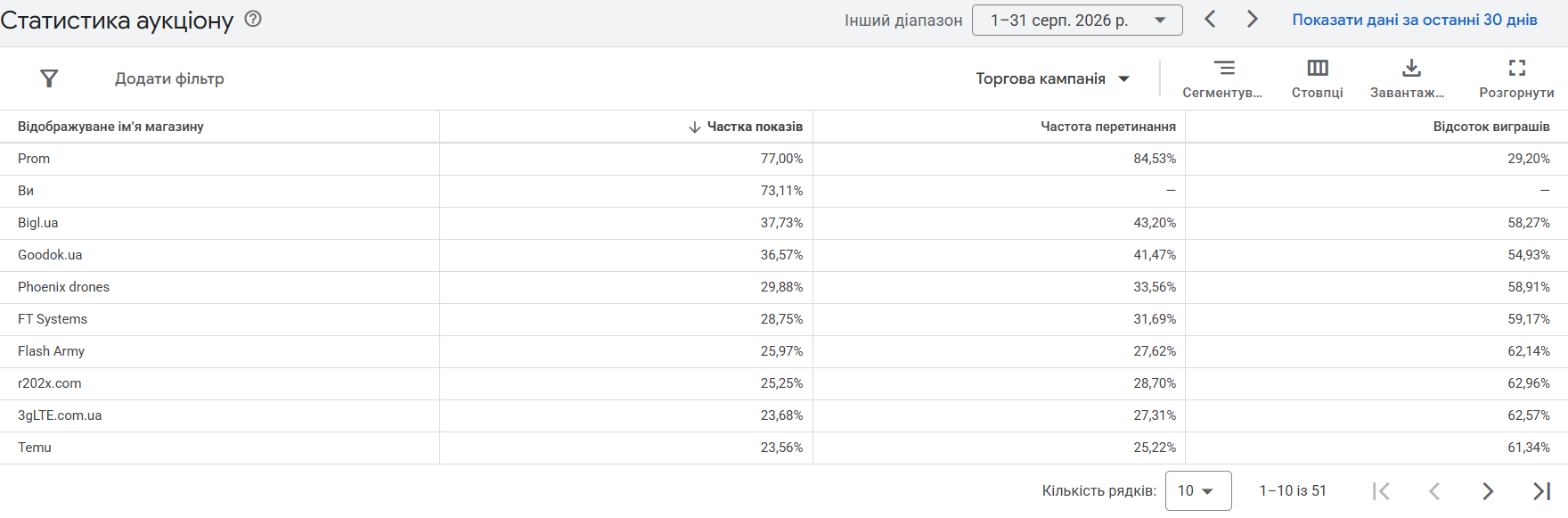
Shopping campaign auction insights for August 2026

Shopping campaign auction insights, August 2026 (interface in Ukrainian). “Ви” (You) is the client’s store; “Відсоток виграшів” (outranking share) shows how often our ad ranked above a competitor’s.

September 2026 in the account. We deliberately do not show the August chart from Google Ads. It would include unpaid order No. 3147 worth UAH 3.16 million, and the account would show a ROAS of 15,893% instead of the real 7,690%. We wrote this case in September using August data, and before publishing we took a snapshot of September, which no longer contains fake orders: 44.19 conversions, UAH 1.13 million in value, 2,650% ROAS on UAH 42.7K spend. From September 10–11, an attack on Horoshop meant the site could not accept orders, so for part of the month the ads ran without sales.
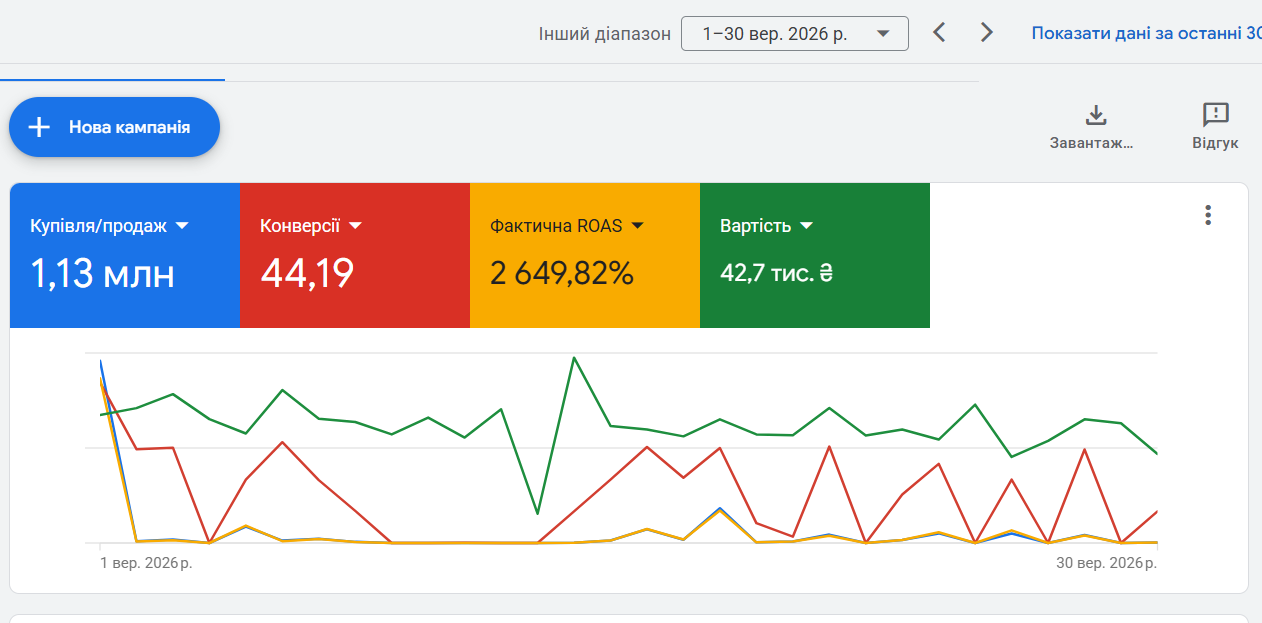
Google Ads, September 2026: purchase value, conversions, actual ROAS and spend

Google Ads, September 2026 (interface in Ukrainian): purchase value UAH 1.13M, 44.19 conversions, actual ROAS 2,649.82%, spend UAH 42.7K.

All time (03/07/2024–10/27/2026): 6,448,273 impressions, 87,489 clicks, 2,357 placed orders, average CPC UAH 11.86, CR 2.69%, CPA UAH 440, spend UAH 1,037,306.

Year over year, the store gets about the same number of orders from ads on a slightly larger budget, but the orders have become several times more valuable. The budget went to the more expensive range, which is exactly what the price segments and priorities are built for. In August 2026, the store’s top products by number of orders were the Skyzone SteadyView X 7.5G receiver (36 orders), the Skyzone VT7550 CNC 7.5G 5W video transmitter (9) and the Brotherhobby SE4215 480kv brushless motor (8). Video transmitters and motors were bought in large batches: 911 and 1,070 units. These figures cover the whole store, not just ads.

What's next

The immediate task is to fully restore order tracking after the attack on Horoshop. A test purchase in October 2026 reached the admin panel but not analytics, and we are working on it now. After that, two ideas are on the table. The first is to restructure campaigns by product category (drones, goggles, parts): we have already proposed this structure to the client, and it will give the algorithms more data to learn from. The second is to import offline conversions from the CRM, so that Google learns from paid orders rather than placed ones. That would finally remove the impact of fake orders on the statistics.

Launch a PPC campaign
We'll prepare a media plan for your store and show you what return on ad spend you can realistically expect in your niche.
Author
Kateryna Zolotareva
Have a question?
Contact us or use the feedback form below