It finally happened. In October 2024, OpenAI’s AI service — the most popular in the world — challenged traditional search engines.
With the ChatGPT Search feature, AI can now search for information across online sources in real time. This innovation poses a serious threat to the monopoly of Google, which holds over 93% of the search market. The same goes for the principles and rules of content creation that were developed over years for specific algorithms. Accordingly, SEO is also in for a shake-up.
With such a powerful search tool on the scene, digital content owners need to understand how to get into ChatGPT Search results — at the very least, to gain an additional channel for promoting their business.
ChatGPT Search is a built-in tool that connects ChatGPT to the internet, allowing it to find and use the latest information from reliable sources in real time.
Unlike the standard model, which works more like an encyclopedia relying on past knowledge, ChatGPT Search is a combination of artificial intelligence and a search engine.
The ChatGPT Search feature is especially useful for finding up-to-date answers to questions about fast-changing events. Interested in sports scores, cryptocurrency prices, or the weather in Paris? Google is no longer the only one that can help.
Although traditional search engines offer a certain set of advanced search tools, the choice of settings is fairly limited and inconvenient to use. ChatGPT Search, by contrast, shows impressive functionality and flexibility:
You search in ChatGPT using natural phrases. The user asks a question as they would ask a person and gets a clear answer in simple conversational form. Instead of a dry Google query like “Kyiv news today”, you can have a relaxed dialogue like this:
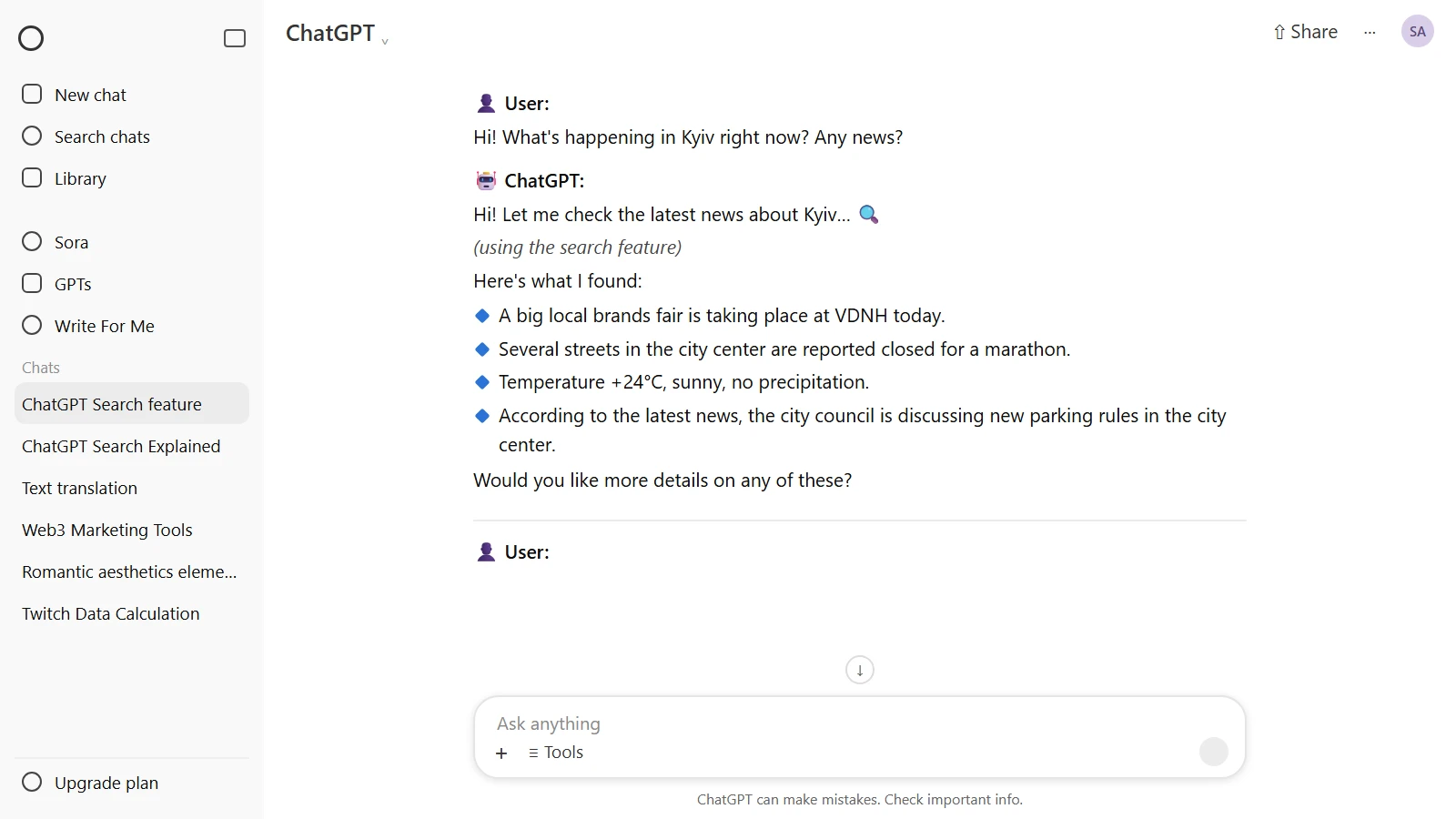
The service lets users ask follow-up questions, and it often continues the dialogue on its own. This makes the search process interactive and the answers comprehensive:
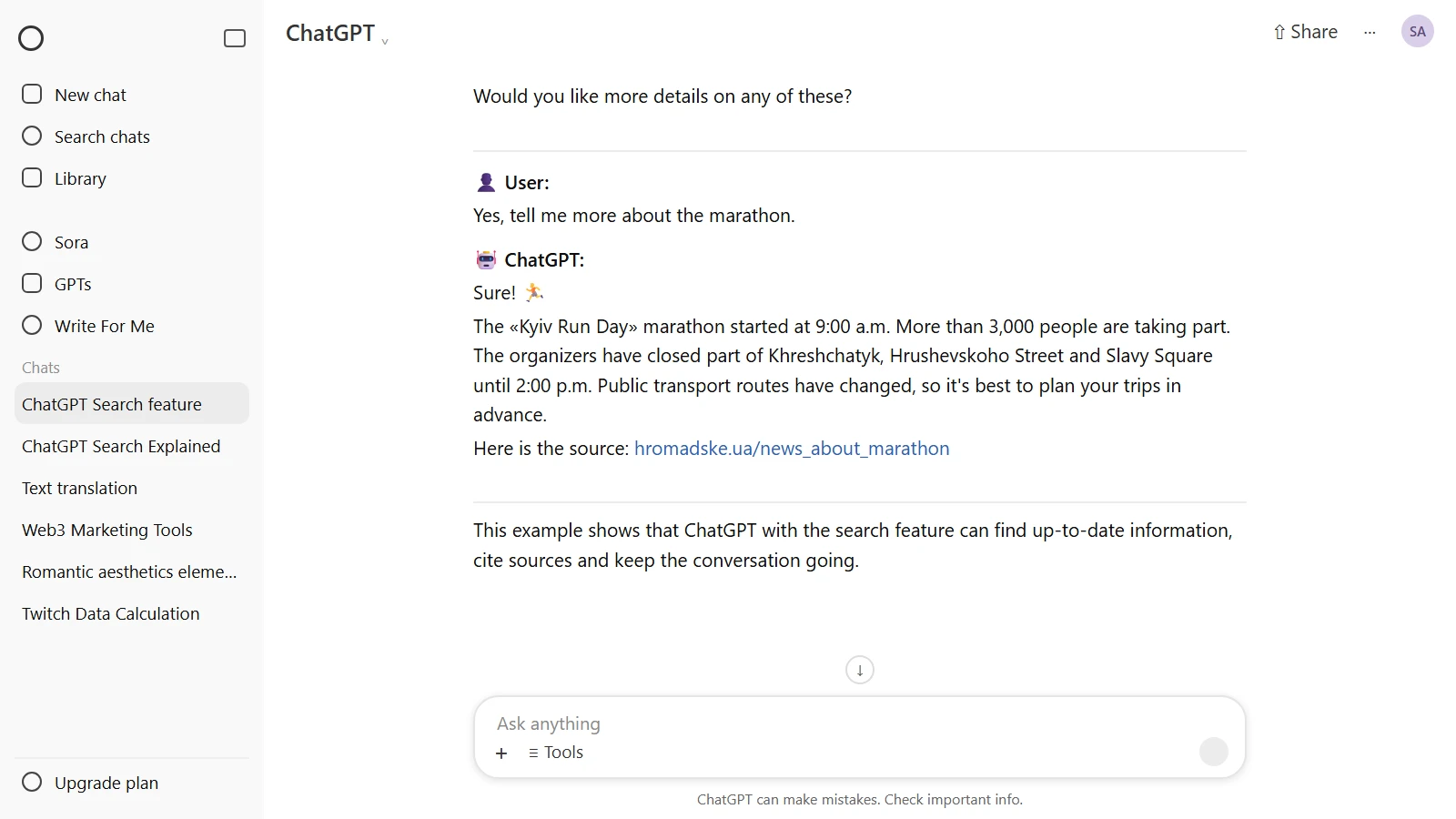
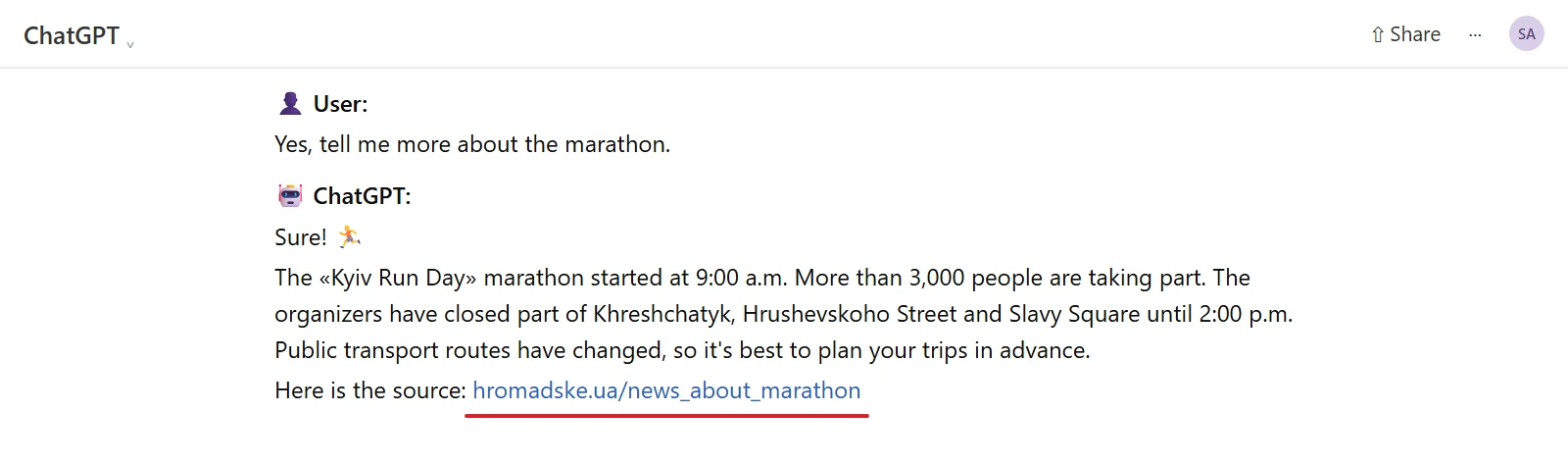
ChatGPT Search answers include clear attribution and links to sources. This lets you verify the information and continue your research on the original websites.
Some answers may include visual elements when they help explain or show the point better. Users can also specify the format they want in the query: charts, bullet points, tables, and images:

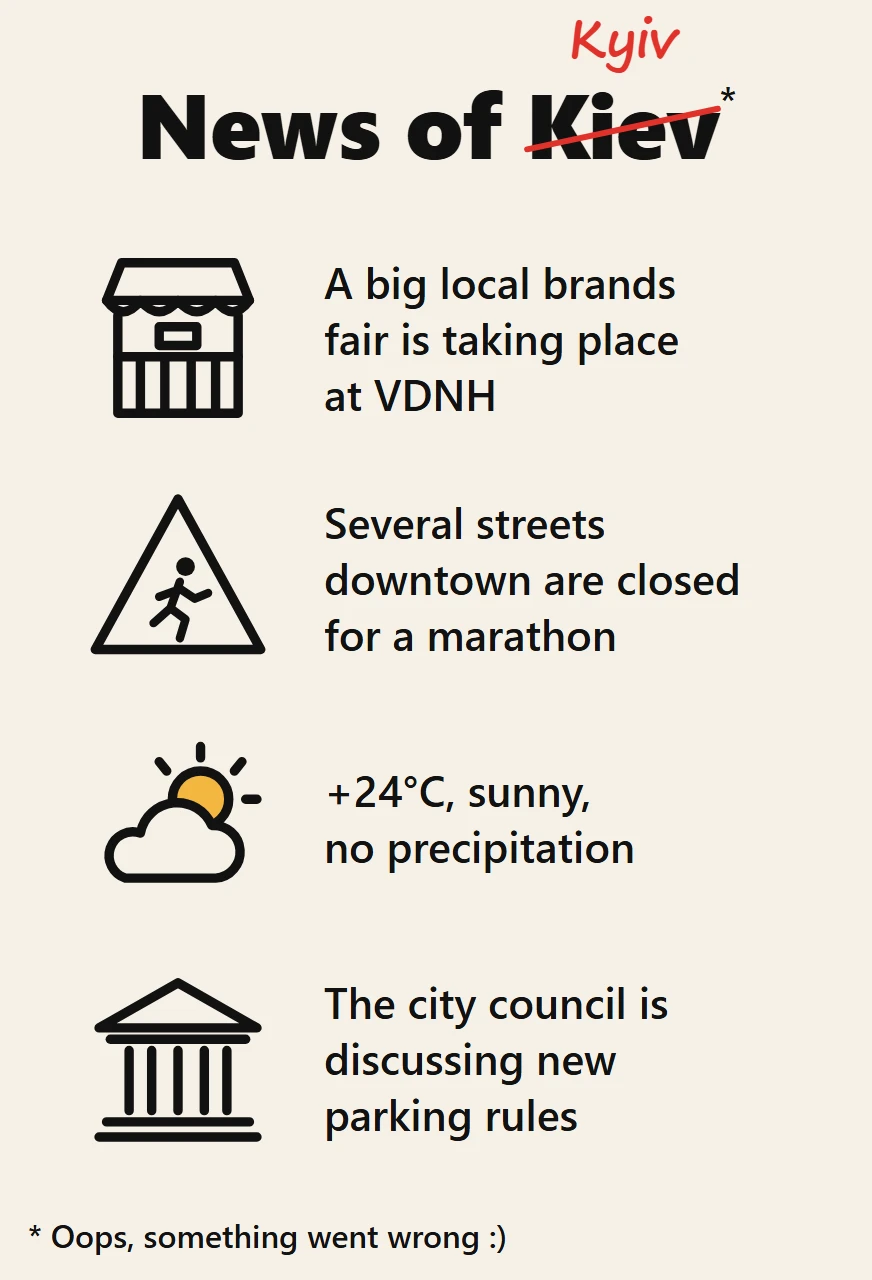
Instead of a long list of links, as in classic search engines, ChatGPT immediately produces a short, clear summary.
Let’s look at how the system works in detail. From your question to the finished answer, ChatGPT goes through a series of automated steps:
- The user asks a question. For example: “What’s new in Kyiv today?”
- The model understands the intent. It “reads” the query, breaks it down, and determines whether fresh information is needed.
- If needed, it goes online. ChatGPT turns on the search feature.
- It builds a query for Bing. The AI rephrases the question into a form the search engine understands well, such as “Kyiv news June 15 2025”.
- It gets a list of websites. The search engine selects relevant links.
- The AI reads the pages. It doesn’t just collect headlines — it “looks inside” the pages and analyzes their content.
- It picks the most useful parts. The AI extracts what matters and skips the rest.
- It writes the answer. You get a short, human-like summary without having to click through dozens of links.
- It adds sources. When needed, ChatGPT shows where the information came from, so you can verify it or dig deeper.
OpenAI’s AI-powered search has many advantages, but it is not without drawbacks.
Let’s start with the factors that may convince you to make ChatGPT Search your search engine:
You don’t need to be an expert. Even without knowing algorithms or search operators, you get a clear, concise, and relevant answer to any question.
The search feature can return data literally minutes after it is published. That’s ideal for news, stock quotes, and trends.
The AI has a good memory. If your previous query was about an event in Kyiv, then when you next ask about prices, it won’t give you grocery prices in Abu Dhabi supermarkets. This eliminates repetition and confusion.
ChatGPT reads websites itself, extracts the essence, processes it, and gives you a precise answer — quickly and logically. So instead of hundreds of links, you get one clear summary. That’s far more efficient than clicking through 10 pages. Everything is on topic, with no filler and no ads. If needed, you can clarify or expand the answer.
There’s plenty to praise, but a few weaknesses are still holding ChatGPT Search back in the race for leadership:
When ChatGPT can’t find the right answer, it sometimes “fills in the gaps” — and, credit where it’s due, it does so very convincingly. In critical fields such as medicine or law, this kind of improvisation can be very costly.
The AI retells the information it finds in its own words. But along with this, the author’s intonation or the brand’s tone disappears. Instead of an authentic voice, you get a uniform text with no personality.
GPT search seems to read the entire internet, but in fact it favors sources approved by the OpenAI team. Alternative or niche but valuable opinions may simply not make it into the results.
Yes, AI makes mistakes. Sometimes they are trivial grammatical errors, as in the Kyiv news example above, and sometimes they are serious distortions of facts. That’s why all answers need careful checking.
If the answer is already here, why open the website? This “zero-click” principle reduces traffic to original sources, which hurts publishers, bloggers, media, and the entire content economy.
Now for the key question: how do you make the most of ChatGPT Search and adapt your content so that AI cites it more often? There are no guaranteed recipes for success, since the technology is constantly evolving, but the following practical tips are worth considering.
What you can do:
OpenAI has agreements with several major media outlets, such as Reuters, AP, Vox, and Axel Springer. So if you are part of a large publication or have access to a platform with a strong reputation, that’s a plus.
Tip: Publish on recognized platforms or build partnerships with them.
ChatGPT extracts the essence from texts. Well-structured content — with headings, subheadings, lists, and short paragraphs — is easier for the model to “read”.
Tip: Follow UX writing principles. One paragraph, one idea.
AI indexes texts better when they contain specific wording similar to users’ queries. For example:
“What is Web3?”, “5 ways to cut business costs”, “How is GPT-4 different from GPT-3.5?”
Tip: Turn your readers’ typical questions into subheadings in your text.
AI favors content that shows signs of expertise (E-E-A-T: Experience, Expertise, Authoritativeness, Trustworthiness). This is especially important for YMYL topics (health, finance, safety, etc.).
Tip: Name the author, state their experience and data sources, and link to research.
AI either doesn’t see paywalled content at all or sees only part of it. This limits your chances of being included in an answer.
Tip: Make the main part of the text freely available, even if the rest is behind a subscription.
From a technical SEO standpoint, the following parameters matter for getting into AI systems:
- Crawlability and indexability.
An XML sitemap, a correct robots.txt, and no 4xx/5xx errors are the foundation, because AI Overviews pull information only from indexed pages.
Canonical tags help avoid duplicate content and make it clear to Google which version to show.
- Page speed and site performance
Core Web Vitals (LCP, CLS, INP/FID) are an important signal both for ranking in ChatGPT and for better UX and user engagement.
Using a CDN, compression, inlining critical CSS/JS, and lazy loading noticeably improves these metrics.
- Mobile optimization and responsive layout
Google AI Overviews are built into mobile SERPs, so your site must be mobile-friendly and load quickly on any device.
- Security and accessibility
HTTPS is a mandatory data transfer standard; site security matters for AI Overviews.
Accessibility (ARIA, alt attributes, contrast): Google takes into account how accessible content is to all users.
- Structured data (Schema.org)
FAQ, HowTo, Article, Product, and other schema types help AI models recognize the key components of your content and easily extract the right fragments. JSON-LD is preferable, as it is the most modern markup format.
- Clear content structure and semantics
Clear H1–H3 headings, short paragraphs, lists, and bullet points are the format AI loves.
Organizing content into topic clusters strengthens semantic connections and entity visibility.
GPT Search is not an alternative to Google but an evolution of the very idea of search. The system is already being integrated into other platforms, learning to work with voice, and adapting to household devices. Clearly, in the coming years it will gain more autonomy, and businesses will face more tasks related to optimizing their sites for AI search.
For content creators, now is the best time to prepare for a new SEO landscape. Give users not just keywords, but clear, verified, and useful answers. Structure your pages, allow access for GPTBot, and above all, focus on quality.
Remember: brands that learn to work with AI will win a new audience. And those who adapt sooner than others will become leaders of the new digital landscape.